We established that so that we can understand horror as a genre, we need to understand fear and what evokes it in an audience. This is what we came up with:
- Things that are uncanny
- Things we don't understand causes a strong emotional response if represented correctly, such as the living dead (zombies).
- Our own death
- Or something possessing our bodies (body snatching).
- Disturbance of family life
- The breaking of the equilibrium we call everyday life.
- Vulnerability
- And the inability to withstand the effects of a hostile environment.
As a class, we also found that throughout the history of horror there are films that get recreated in a new, 'modernised' way over and over again. This we gave the label of 'canon' as these stories have influenced and inspired so many horror films. Under this label we put the films 'Dracula' and 'Frankenstein'.

Dracula was first written as a play in 1897 and was developed into a German film called Nastferatu (1922), directed by F.W.Murnau and starring Max Schreck as Count Orlok. Due to it being an unlicensed version of the novel that they were sued and all copies were ordered to be destroyed, only to be restored in 1994 by a group of European scholars using the surviving five prints that escaped destruction. A key aspect which proceeded to have a huge influence on the representation of vampires in the media was in the lasst scene where the vampire was destroyed by sunlight, rather than the traditional stake through the heart.
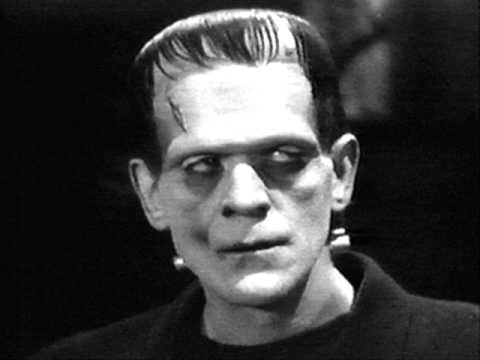 Frankenstein was first a film in 1910 but the version that has influenced the representation of Frankenstein today was the 1931 adaptation, directed by James Whale, Universal Studios. This is the version where Frankenstein is presented with the typical oblong-shaped head, bolt through the neck and scars on his face. This film plays with the audience's fear of the uncanny and the living dead, and due to it being such a success as a horror film, influenced spin-off films such as 'Bride of Frankenstein'.
 Another classic film is 'The Cabinet of Dr. Caligari', which is about a mad hypnotist who used his hypnotised victims to commit murders. It is a silent film put together by the German director Robert Wiene in 1920. It is considered the quintessential work of the German expressionist cinema as it was full of abstract sets in a dark, twisted style with straight, pointy lines juxtaposed with curved ones.
 The film was inspired by the World War experiences of the two script writers, Hans Janowitz and Carl Mayer, who were both pacifists. The film reflects the brutal and irrational authority that was displayed during the war; Dr. Caligari represents the German government during the war, and Cesare is symbolic of the common man conditioned, like soldiers, to kill.
During the 1960's there was a further development that came with emerging roles of women in society. What is meant by this is that there were now women protagonists in horror films, such as in 'The City of the Dead' and 'Psycho' in 1960, 'Carnival of Souls' in 1962 and so on. Around the same time there was the Civil Rights Movement, this monumental moment in history was emphasised in the film industry with the release of the film 'The Night of the Living Dead', directed by Tom Savini in 1968, with one of the key characters being a young black man who was represented as a kind and intelligent man, a completely different way as to how they were presented before the movement.
Another significant advancement of horror as a genre was Tom Savini himself, a special effects artist, who fought in the Vietnam War.
"If I'm creating a gory effect and I don't get the same feeling when I saw the real stuff, I'm not satisfied." - Tom Savini
This was a revelation for horror as this was the first time in horror films where the 'monster' wasn't far from reality. This spooked audiences as it was a disturbance of the family life, and as a result, was an incredibly successful horror technique.
'The Cabin in the Woods' is a more recent horror film from 2011 about five friends who go to a remote cabin in the woods and "bad things happen". This film is particularly horrifying as it is so close to reality in the sense that there are no supernatural elements to it, that it is psychologically challenging.
 This psychological factor seems to have become a trait amongst horror films in the 21st century, such as in 'Saw', where the horror lies in the situation that the victims find themselves in and a mysterious serial killer who is unidentified. This lack of knowledge would mean that the 'bad guy' has a powerful leverage over the victim and this, in turn, evokes an empathetic fear for the victim.
Other codes and conventions that are common in the more recent horror films are based on extreme violence and body horror, as well emotionless psychopathy. Due to a break through in technology, computer generated images (CGI) has given film makers the ability to bring to life new terrors that people had never heard of before. This opened up a whole new aspect to horror and as a result a whole new range of films were produced, such as 'Trick 'r Treat' (2007) and 'Insidious' (2010).
Another technique commonly used, that has also been used in the past, is the shaky cam effect which emphasises the feeling of disorientation in the audience. The shaky footage draws the viewers in and is usually used as a point of view shot, making it more realistic and authentic, consequently putting the audience more on edge as they feel more of a part of the story. This type of shot is used in the films, 'Blair Witch Project' (1999), where the clips used is "found" footage, and, 'Cloverfield' (2008) in order to heighten the suspense even further.

No comments:
Post a Comment